8
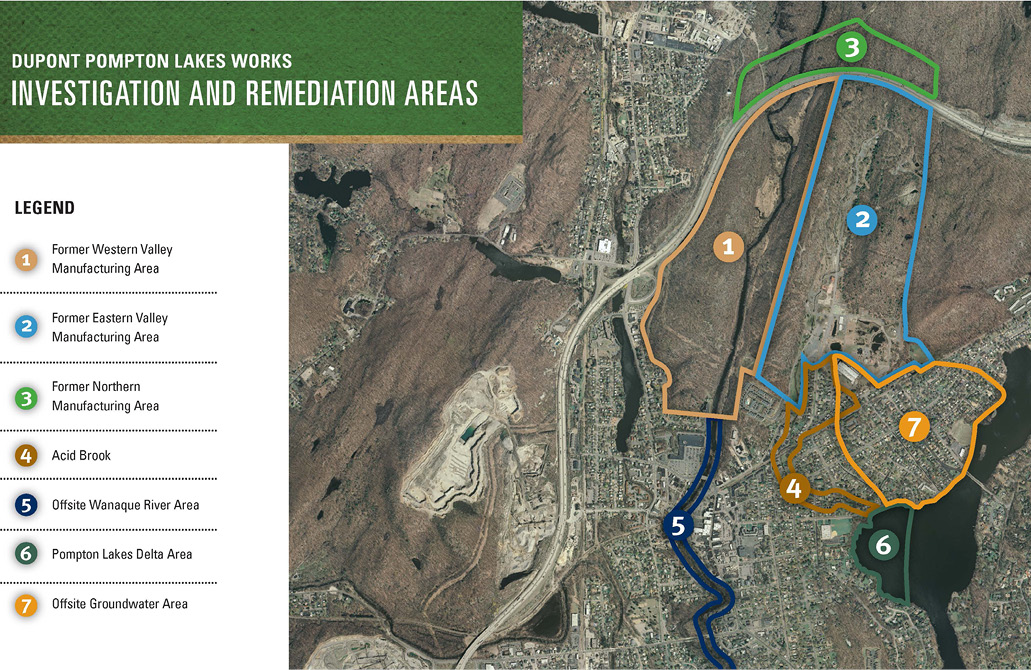
Official site map,
Pompton Lakes Works Remediation Project Information Center
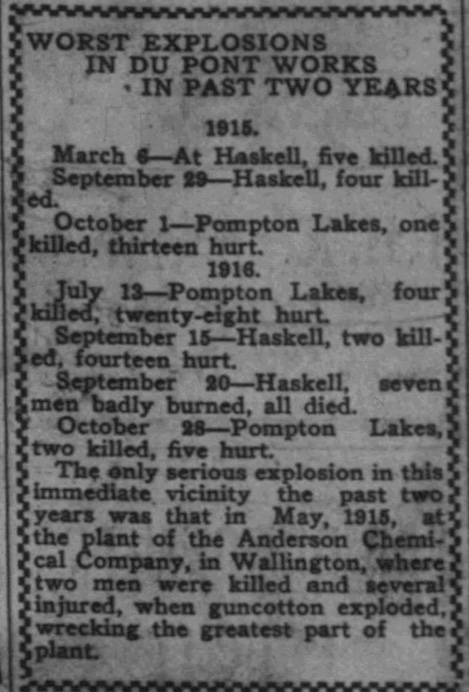
“Worst Explosions In DuPont Works In Past Two Years,” Passaic Daily News, January 13, 1917, Page 1
7
Many such signs can be found in Pompton Lakes, but not only at the quarry. The three-square-mile borough’s largest swath of “lost land,” totaling 576 acres, is DuPont’s Pompton Lakes Works, which spills over into the Haskell section of neighboring Wanaque to the north. A mountainous tract of woodlands bordered on three sides by public parkland, it’s hard to imagine that it was once a major center of munitions manufacturing, producing everything from “sporting powders” for hunting to cutting-edge explosives for various American war efforts. While it has been known by many names over the years, with its predecessors operating in some form from 1886 to 1994 and ownership changing hands even after its closure, the development of Pompton Lakes was closely linked to the site, predating the founding of the borough in 1895.
A cultural resource survey of the borough conducted in 1992 by Sullebarger Associates mentions in its acknowledgements that its grant funding was “matched by E.I. DuPont de Nemours & Company, whose Pompton Lakes facility is one of the Borough’s oldest continuing industries,” failing to foresee its imminent closure (Sullebarger ii). Its opening historical narrative states “DuPont has been a local presence since [its arrival], and much of the architectural legacy of the Borough is a direct result of that presence,” with the footnote on this sentence reading, in part, “The DuPont operations...were not surveyed due to inaccessibility,” (Sullebarger xiii). The conflicting interests of their sponsors may have been showing, as at the time, litigation had recently begun to hold DuPont accountable for the carcinogenic pollutants that had been found in groundwater onsite and nearby. Even before this, the property was known for being inaccessible; “Despite its size,” reads a 1973 article on the plant, “the work within the fenced-in compound off Cannonball Road is a mystery to most area residents.” The manager is quoted as stating, “We have an inconspicuous, quiet existence,” touting its safety record. This may have
been true in the seventies, but earlier that century, the plant exploded on an almost regular basis, as made evident by the 1917 proto-listicle “Worst Explosions In DuPont Works In Past Two Years.” Apparently, this was still a concern for DuPont in 1978, when the company acted to prevent the rezoning of part of its land, which “has been retained by DuPont as a buffer zone to guarantee the safety of residents and property in case of an explosion at the chemical plant.” Another historical survey, completed in 1980 for the construction of Interstate 287 through the property, cites the New York Times’ July 14, 1917, issue, when employees numbered over 7,500 and the plant covered four square miles with 500 buildings (Hunter 10). Arriving at its maximum size by the merging of three separate plants under the DuPont name, each has distinct physical remnants present even today on an immense plot of land controlled by their corporate interests. The site’s size, restrictions to access, and histories of explosive pollution and denial have created a contentious relationship with the town’s residents, one of whom is me. The story of the making and breaking of a company town is legible in a forbidden landscape, through which I will offer you a tour.
8
Official site map,
Pompton Lakes Works Remediation Project Information Center
“Worst Explosions In DuPont Works In Past Two Years,” Passaic Daily News, January 13, 1917, Page 1